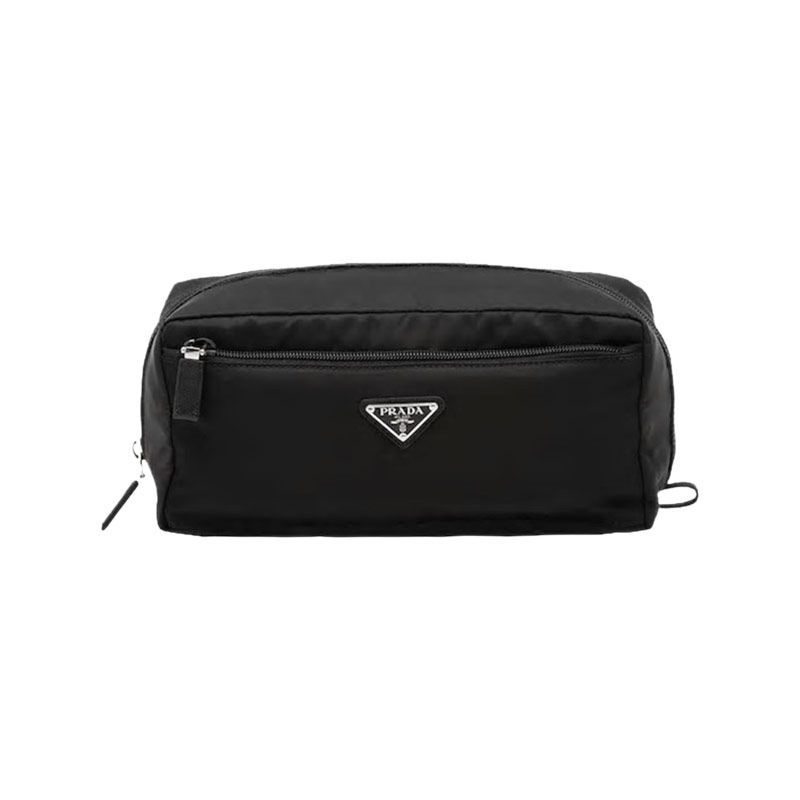
Prada Nylon and Saffiano Leather Travel Pouch
- No Warranty
- Ringkasan
- Brand
- Model No.2NA029_064_F0002
- Weight (after packing)700 Gram
- MaterialLeather
- CompositionNylon lining 12 cm Height 14 cm Length 26 cm width.
- DetailProduct code: 2NA029_064_F0002 A practical and elegant cosmetic pouch. The Saffiano leather detailing and triangular Prada logo add embellishment while the spacious internal compartments and two external pockets are practical.
- Additional InformationEnameled metal triangle logo on the front Zipper closure Two outer zipper pockets Inside zipper pocket.
- Syarat Pengembalian
- Barang belum dipakai sama sekali
- Kelengkapan barang masih sama seperti awal dikirimkan (termasuk plastik pembungkus)
- Estimasi Pengembalian3 Hari
- What's Inside Box1x Prada Nylon and Saffiano Leather Travel Pouch
Prada S.p.A. (/?pr??d?/ PRAH-d?, Italian: [?pra?da]) is an Italian luxury fashion house that was founded in 1913 by Mario Prada. It specializes in leather handbags, travel accessories, shoes, ready-to-wear, perfumes and other accessories.
The company was started in 1913 by Mario Prada and his brother Martino as a leather goods shop – Fratelli Prada – in Milan, Italy.] Initially, the shop sold animal goods and imported English steamer trunks and handbags.
Mario Prada did not believe that women should have a role in business, and so he prevented female family members from entering his company. Ironically, Mario's son harbored no interest in the business, so it was Mario's daughter Luisa Prada who took the helm of Prada as his successor and ran it for almost twenty years. Her own daughter, Miuccia Prada, joined the company in 1970, eventually taking over for her mother in 1978.
Miuccia began making waterproof backpacks out of Pocone, a nylon fabric. She met Patrizio Bertelli in 1977, an Italian who had begun his own leather goods business at the age of 24, and he joined the company soon after. He advised Miuccia on company business, which she followed. It was his advice to discontinue importing English goods and to change the existing luggage.
Miuccia inherited the company in 1978 by which time sales were up to U.S. $450,000. With Bertelli alongside her as business manager, Miuccia was allowed time to implement her creativity in the company's designs. She would go on to incorporate her ideas into the house of Prada that would change it.
She released her first set of backpacks and totes in 1979. They were made out of a tough military spec black nylon that her grandfather had used as coverings for steamer trunks. Initial success was not instant, as they were hard to sell due to the lack of advertising and high prices, but the lines would go on to become her first commercial hit.
Next, Miuccia and Bertelli sought out wholesale accounts for the bags in upscale department stores and boutiques worldwide. In 1983, Prada opened a second boutique in the centre of the Galleria Vittorio Emanuele in Milan's shopping heart, on the site of the previous historic "London House" emporium run by Felice Bellini from 1870 to the 1960s, reminiscent of the original shop, but with a sleek and modern contrast to it.
The next big release was a nylon tote. That same year, the house of Prada began expansion across continental Europe and the United States by opening locations in prominent shopping districts within Florence, Paris, Madrid, and New York City. A shoe line was also released in 1984. In 1985 Miuccia released the "classic Prada handbag" that became an overnight sensation. Although practical and sturdy, its sleek lines and craftsmanship had a luxury that has become the Prada signature.
In 1987 Miuccia and Bertelli married. Prada launched its women's ready-to-wear collection in 1989, and the designs came to be known for their dropped waistlines and narrow belts. Prada's popularity increased when the fashion world took notice of its clean lines, opulent fabrics, and basic colors.
The logo for the label was not as obvious a design element as those on bags from other prominent luxury brands such as Louis Vuitton. It tried to market its lack of prestigious appeal, including of its apparel, by projecting an image of "anti-status" or "inverse snobbery".
 Tidak tersedia